Rotating Shift Schedules: Patterns, Pros, Cons, and How to Implement One
A rotating shift schedule cycles employees through different shifts over a set period instead of assigning the same shift every week. Done well, it distributes less desirable hours fairly and keeps operations covered around the clock. Done poorly, it burns people out. Here's how to get it right.
What a rotating schedule actually means
In a fixed schedule, an employee works the same hours every week. In a rotating schedule, their shift changes on a predictable cycle. An employee might work mornings for two weeks, then afternoons for two weeks, then nights for two weeks before the pattern repeats.
This prevents any single employee from being permanently stuck on the least popular shifts. It's most common in businesses that need 24/7 or extended coverage: manufacturing, healthcare, security, and hospitality.
Common rotation patterns
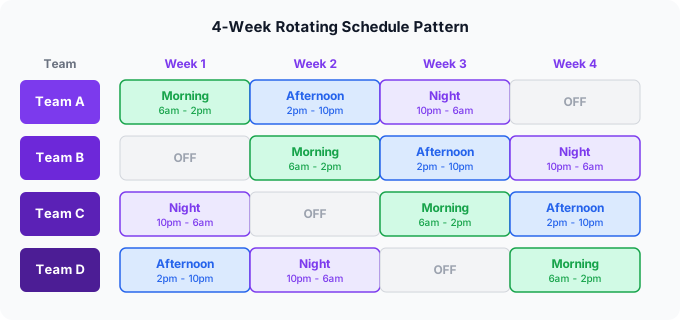
4-team, 3-shift rotation
Four teams rotate through three 8-hour shifts (day, evening, night). At any given time, three teams are working and one is off. Teams typically rotate every week or every two weeks.
This is the most straightforward 24/7 coverage model. It works well for mid-size operations with enough staff to form four distinct teams.
2-2-3 schedule (also called the Panama schedule)
Employees work 12-hour shifts following a pattern: 2 days on, 2 days off, 3 days on, then the pattern flips. Over a two-week cycle, every employee works both weekdays and weekends and gets every other weekend off.
The appeal is the built-in long weekends and the simplicity of 12-hour blocks. The downside is that 12-hour shifts cause more fatigue, especially during night rotations.
DuPont schedule
A four-week cycle where employees rotate through day and night shifts with a 7-day break built into each cycle. The pattern is: 4 nights on, 3 off, 3 days on, 1 off, 3 nights on, 3 off, 4 days on, 7 off.
The week-long break is the main selling point. But the schedule is complex to explain, and the transition from nights to days can be hard on employees.
Pros of rotating schedules
Fairness. Nobody is permanently assigned to the graveyard shift. Everyone shares less desirable hours over time, reducing resentment and turnover.
Skill distribution. Every shift benefits from a mix of experienced and newer employees rather than concentrating talent on one shift.
Flexibility for employees. Rotating schedules give employees variety and ensure they get some weekday time off for appointments and personal obligations.
Consistent coverage. A well-designed rotation guarantees every shift is covered without relying on volunteers or overtime.
Cons of rotating schedules
Circadian disruption. Switching between day and night shifts is hard on the body. Slower rotations (every 2-4 weeks) are easier to adjust to than weekly flips.
Communication challenges. When teams rotate, information handoff becomes critical. Context gets lost when the people working today aren't the same ones who were here yesterday.
Complexity. Rotating schedules are harder to build, harder to explain, and harder to adjust than fixed schedules. Employees need clear documentation so they can plan their lives around the rotation.
Not for everyone. Some employees have caregiving responsibilities or health conditions that make rotating shifts genuinely difficult. Build in an accommodation process.
How to implement a rotation fairly
Pick the right pattern for your operation
Don't choose a pattern because it looks good on paper. Match it to your actual needs. If you only need extended hours (not 24/7), you probably don't need a full rotation. If fatigue is a concern, avoid 12-hour shifts.
Involve your team early
Announce the change well in advance. Explain why you're moving to rotation, show the pattern, and answer questions. Collect feedback after the first full cycle and adjust if something isn't working.
Start with a pilot
Test the rotation with one team or department before rolling it out company-wide. A four-week pilot gives you enough data to spot problems without committing to a permanent change.
Document and monitor
Publish the full rotation calendar at least 4-8 weeks in advance and make it accessible digitally. Track attendance, overtime, and employee feedback during the first 2-3 cycles. If one shift consistently has higher call-outs, the rotation may need rebalancing.
When rotation makes sense vs. fixed shifts
Rotating schedules are worth the complexity when you have extended operating hours, enough staff to form distinct teams, and a fairness problem with your current approach. If your business runs standard hours and employees are happy with their shifts, fixed scheduling is simpler. The deciding factor: are the "bad" shifts causing turnover? If yes, rotation solves a real problem.
Try Timely free for 7 days and set up your rotating schedule pattern in minutes instead of wrestling with a spreadsheet.
Ready to simplify your scheduling?
Try Timely free for 7 days. Set up your team, build your schedule, and see the difference in minutes.
Start Your Free Trial →